The Decision Every SaaS Founder Faces
AI First MVPs: A Founder’s Guide

Zubair Ali Akbar
Every founder pitching an AI first product wants to build the same MVP: a full AI system that trains on user data, personalizes to each account, and gets smarter over time. That MVP takes 6 months to build and rarely ships.
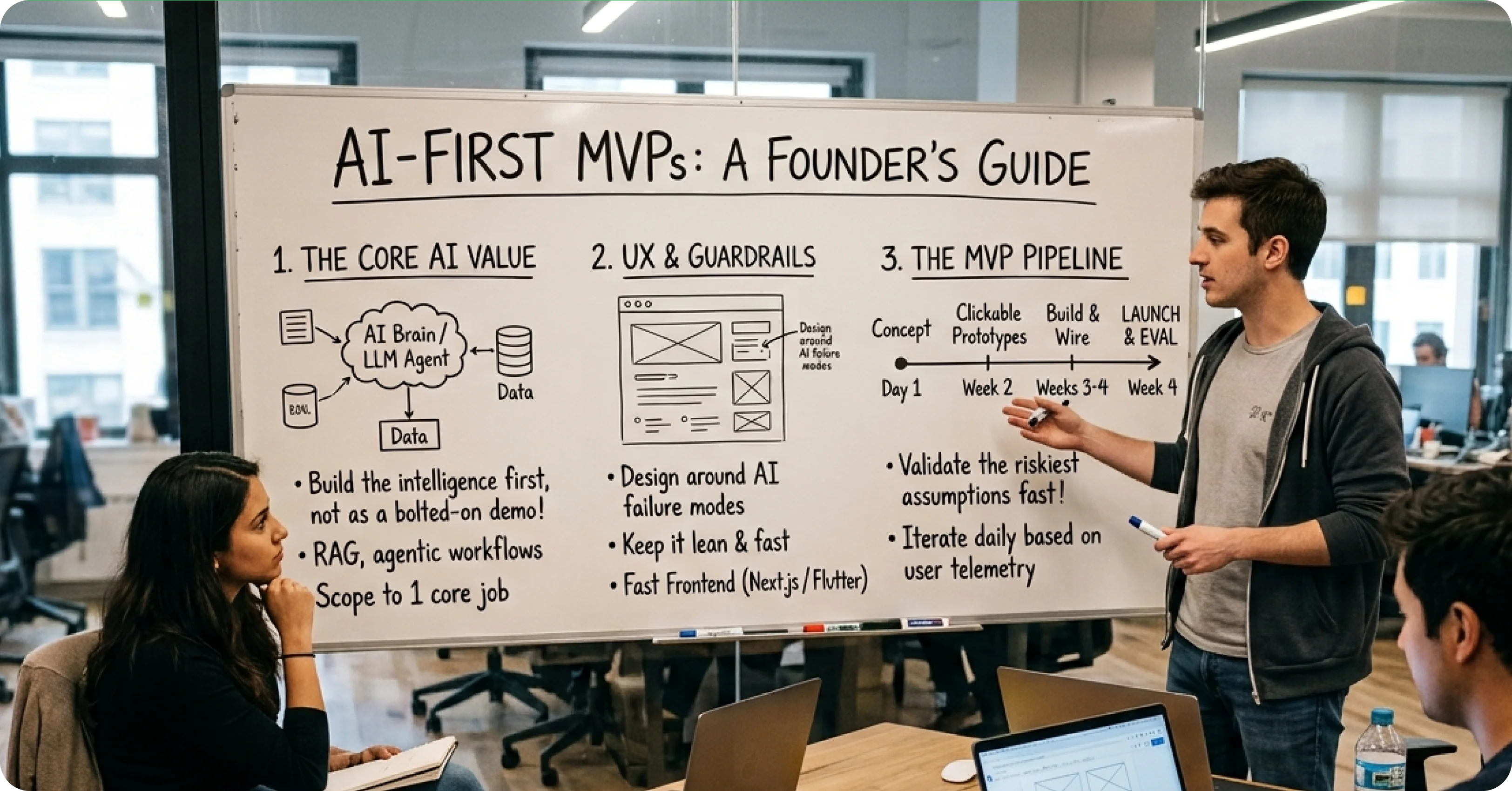
Here is how to actually get an AI first MVP live in 8 to 12 weeks.
Rule 1: Do not build models. Use APIs.
Custom models make sense at scale, not at MVP stage. OpenAI, Anthropic, and Cohere deliver frontier model performance via API for pennies per request.
Your MVP’s job is to prove people want the product, not to have technical moats. Save custom model work for after you have paying users demanding better.
Rule 2: Design for the model’s failure mode
Every AI feature will fail sometimes. The MVP question: what does the user see when it fails?
Weak MVP: AI returns wrong answers with the same confidence as right ones. Users lose trust after two mistakes.
Strong MVP: AI shows confidence levels, offers “I am not sure” as valid response, has clear path to human help when it cannot answer.
Design the failure mode as carefully as the success mode.
Rule 3: Cache aggressively
AI API calls cost money and add latency. Cache responses when possible. If two users ask the same question, one API call should serve both.
This one decision cuts costs by 40 to 60% and improves perceived speed by 30%. Simple time based cache (invalidate after 24 hours) works fine for MVP.
Rule 4: Ship the workflow, then add AI
Biggest MVP trap: designing the AI feature before validating anyone wants the underlying workflow.
Ship the workflow first. Even manually on the back end. If users do not want the workflow when humans do it, they will not want it when AI does.
Once the workflow works, replace manual steps with AI one at a time. Measure whether AI makes it better, not just faster.
What to build in an AI first MVP?
The 3 to 5 workflows that actually validate the hypothesis. One high-impact AI feature (like intelligent search or automated summarization) that clearly saves time. Basic auth, billing, and user management. Clean, fast interface for core workflows.
What to defer past MVP?
Custom model training. Multi-model orchestration. Fine-grained personalization. AIpowered admin dashboards. Voice interfaces. Multi-modal features.
Get validation before adding sophistication.
Common overbuild patterns
Overbuild 1: Multiple AI providers. MVPs need one. Pick OpenAI or Anthropic. Add fallbacks after real users complain about specific edge cases.
Overbuild 2: Real-time streaming everywhere. Streaming is expected for long-form generation. For most AI features, waiting 2 seconds for complete response is fine and simpler to build.
Overbuild 3: Custom evaluation frameworks. You do not need eval pipelines in MVP. You need users clicking thumbs up or down.
Overbuild 4: Vector database optimization. Any vector database works for MVP-scale data. Do not spend two weeks optimizing embeddings when the difference is negligible.
Cost realities for AI MVPs
For MVP with modest usage (few hundred users), monthly AI API costs typically run $50 to $500. Not thousands.
If your MVP AI costs project at $10K+ per month, either you have unusually high per-user usage (audit the design) or your projections are wrong.
Timeline reality
An AI-first MVP with meaningful features ships in: - 4 to 6 weeks: single AI feature added to standard product - 6 to 10 weeks: two or three AI features integrated into full workflow 10 to 16 weeks: AI-first product where AI is core to every feature.
Anyone quoting 3 to 4 weeks for AI-first product MVP is underscoping.
The most important MVP question about AI
If we removed AI from this feature, would users still get value from the workflow?
If yes, you are building a good workflow that AI accelerates. Good MVP.
If no, you are building an AI demo. Users play once and never come back.
Building an AI-first MVP? We ship AI-integrated MVPs in 8 to 12 weeks. Book a 30 minute call.
.webp)