The Decision Every SaaS Founder Faces
RAG vs Fine Tuning: Which AI Approach for Your Feature

Zubair Ali Akbar
Two dominant approaches for building AI features in your SaaS product exist in 2026: Retrieval Augmented Generation (RAG) and fine tuning. Most founders and engineering leads get this decision wrong. Here is the framework.
What RAG actually is:
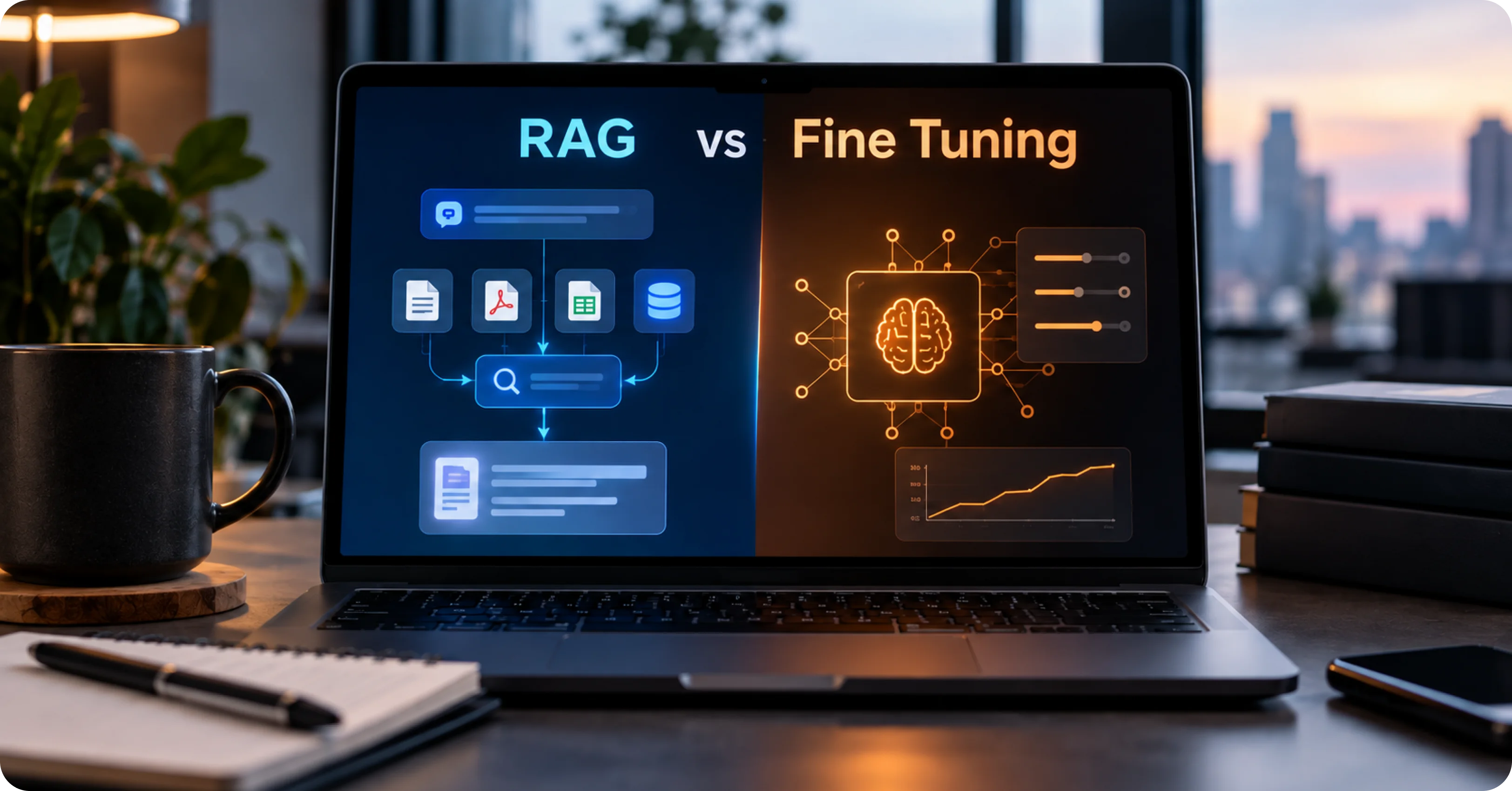
RAG retrieves relevant information from your data at query time, then feeds that information to a general-purpose model like GPT 4 or Claude as context. The model generates a response based on the retrieved context, not from training memory.
Simplified: Ask a question. System finds relevant docs. Model reads those docs and answers.
What fine tuning actually is:
Fine tuning modifies a base model’s weights using your specific data. The model “learns” your data as part of its training. When you query the fine-tuned model, it responds based on absorbed knowledge.
Simplified: Train the model on your data. It then answers based on what it learned.
When RAG wins:
Your data changes frequently. RAG queries current data at question time. Fine-tuned models know only what they were trained on.
You need source attribution. RAG returns specific documents that generated the answer. Fine-tuned models cannot cite sources reliably.
You have modest data volume. RAG works well with hundreds to thousands of documents. Fine tuning needs more.
You want faster iteration. Update RAG by updating your data. Fine-tuning requires retraining, which takes hours.
You have limited AI budget. RAG uses standard model APIs. Fine-tuning has upfront training costs.
Most B2B SaaS AI features fit RAG better than fine tuning.
When fine tuning wins:
You need consistent tone or format. Fine-tuning bakes style into the model. RAG relies on prompt engineering, which is less consistent.
You have very large, stable data. Fine-tuning with 100,000+ examples produces models that outperform RAG on narrow tasks.
You need lower latency. Fine-tuned models respond faster than RAG (which requires retrieval step).
You handle highly sensitive data. Fine-tuning can run on smaller open-source models you self host. RAG typically uses hosted model APIs.
The hybrid approach
Some teams combine both. Fine-tune a model for your domain’s tone and knowledge. Add RAG for real time data lookup.
Example: A financial SaaS fine-tunes a model on financial concepts, then uses RAG to pull current market data for each query. Model has domain fluency, RAG provides fresh facts.
The decision framework in one paragraph
Start with RAG. It is faster to build, cheaper to run, and easier to update. Only consider finetuning if RAG hits a specific limitation (consistency, latency, or scale) that RAG cannot solve. Most SaaS teams never need to fine-tune.
Cost comparison in 2026
RAG monthly cost for a mid-size B2B SaaS AI feature: $50 to $500 per month in API calls plus $50 to $200 per month in vector database hosting.
Fine-tuning cost: $1,000 to $10,000 upfront training cost, then $200 to $2,000 per month in inference. Retraining costs additional.
For most MVP-scale features, RAG wins on both cost and time to ship.
Common mistakes
Mistake 1: Trying to fine-tune before validating the feature. Ship RAG first. If usage warrants investment, then consider fine-tuning.
Mistake 2: Using RAG without proper embedding models. Cheap embeddings produce poor retrieval. Use OpenAI text-embedding-3-large or Cohere embed-v3 for production RAG.
Mistake 3: Assuming fine-tuning fixes hallucinations. It reduces them but does not eliminate them. RAG with grounding is often more reliable.
Building an AI feature in your SaaS product? We help teams pick the right architecture (RAG, fine-tuning, or hybrid) and ship AI features that actually work. Book a 30-minute call.